

Cloisonne
What is Cloisonné?
Cloisonné is a French term meaning “cells”, which form the basis of every design. Cloisonne is a beautiful decorative art, with brilliant colours, intricate detail, and requiring a high level of craftsmanship.
I shape and attach fine silver wires to a sterling silver base to create a pattern of compartments. I then fill these compartments with finely ground enamel – powdered and coloured glass. Next, I fire the piece is fired in my kiln, melting the enamel so that it permanently bonds with the metal. The enamel settles during firing, requiring me to repeat the process many times, with each firing adding a richness of colour. Finally, I ground and polish the surface until it is smooth, revealing the glowing enamel and fine metal lines that define the design.
The origins of cloisonné stretch back thousands of years. Early examples were found in Egypt, Greece and the Byzantine Empire. By the 13th and 14th centuries, the technique had reached China, where it flourished and became synonymous with magnificent decorative objects. Japan embraced cloisonné during the seventeenth century and elevated it to extraordinary artistic heights. Workshops around Nagoya became internationally renowned for producing exquisite cloisonné that was exported throughout Europe and America. Visitors, including Rudyard Kipling, marvelled at the patience and skill involved.


My Fascination with Cloisonné
I love that there are no shortcuts when I am making cloisonne. A single design will involve many hours of shaping fine silver wire, applying multiple layers of enamel, firing the piece repeatedly, then grinding and polishing until the surface is perfectly smooth.
An important influence has been Archibald Knox. I was fortunate to inherit one of his beautiful pewter clocks that contains acloisonne dial from my grandmother, and it remains one of my treasured possessions. His dedication to quality handmade craftsmanship had a big impact on my approach.
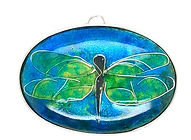

My Interpretation of Cloisonne
While I respect the old traditions of cloisonné, I also believe every artist should bring their own perspective to this remarkable craft. My cloisonne jewellery reflects my love of Australia's extraordinary wildlife and natural environment.
Traditional Japanese cloisonné often celebrates flowers, cranes and butterflies. I draw inspiration from the same appreciation of nature, but my subjects are unmistakably Australian.
One of my favourite birds to depict is the Gouldian Finch. Its extraordinary combination of colours seems almost designed for enamel. I am equally inspired by Australia's fairy-wrens, galahs and sulphur-crested cockatoos. Each species has its own personality, colour palette and movement, offering endless opportunities for interpretation in enamel.
Flowers also lend themselves to cloisonne design.
Australia's marine life also fascinates me, particularly the remarkable Leafy Seadragon and Lion Fish.
Butterflies and native flowers also feature in my work. The magnificent Cairns Birdwing Butterfly, with its dramatic wings and vibrant colours, is a favourite.
Every piece I create begins as a hand-drawn design. The subtle variations created during firing mean that every piece is one of a kind.
Through my work I hope to introduce more people to the beauty of cloisonne

